
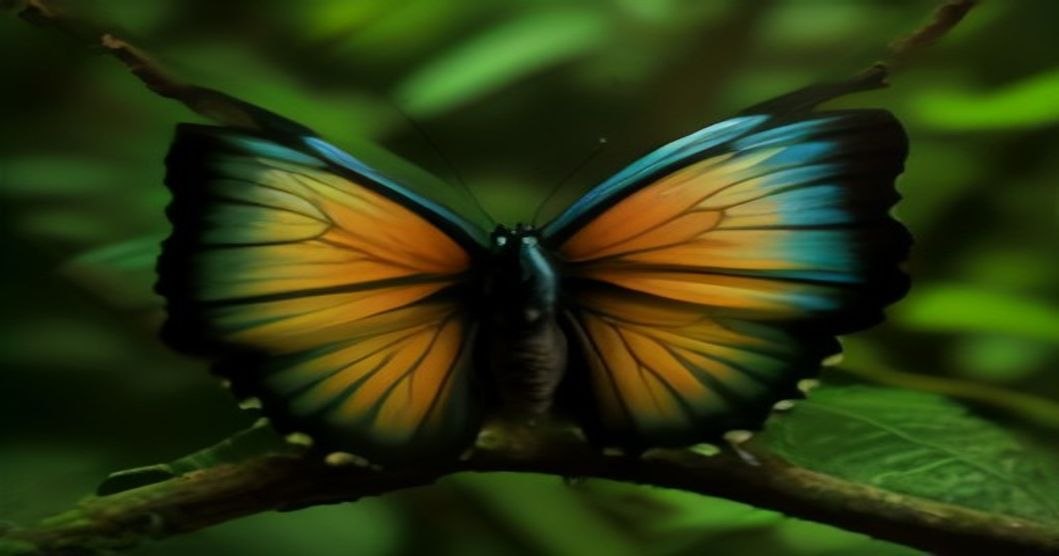
Introduction to Kallima Inachus: The Master of Disguise
In the vast world of entomology and natural science, few species capture the wonder of evolutionary adaptation quite like Kallima inachus, commonly referred to as the Orange Oakleaf or Dead Leaf butterfly. Belonging to the family Nymphalidae, this day-flying insect stands as a classic textbook example of protective coloration and crypsis—a defense mechanism where an animal avoids observation or detection by blending into its environment.
Morphological Features: A Striking Dual Aesthetic
With an impressive wingspan ranging from 60 to 110 millimeters, Kallima inachus is a relatively large butterfly. What makes this species truly breathtaking is the stark contrast between the upper and lower surfaces of its wings. The dorsal (upper) side exhibits a vibrant display of brilliant metallic blue with a rich luster, bordered by bold orange bands across the forewings. This bright coloration plays a crucial role during flight, visual signaling, and mate attraction.
The Perfection of Mimicry: Converting into a Dry Leaf
Conversely, the ventral (underside) of the wings is a triumph of natural selection. Highly variable in shade and texture, the underside impeccably mimics a dead, withered leaf. Complete with a distinct central vein line, subtle fungal-spotting patterns, and a petiole-like tail structure on the hindwings, the visual deception is near perfect. When threatened or resting, Kallima inachus alights on a branch, snaps its wings closed, and presses the short hindwing tail projections firmly against the bark. To predators such as birds and lizards, as well as human observers, the insect instantly transforms into a lifeless, dried leaf hanging among the foliage.
Geographic Range and Natural Habitat
This remarkable insect inhabits the lush, humid forest ecosystems of South Asia and Southeast Asia. Its natural distribution spans across India, Nepal, Bhutan, Bangladesh, and Myanmar. Within these dense, vegetation-rich habitats, the butterfly navigates the forest undergrowth, canopy edges, and damp streambeds, relying on its rapid flight to escape danger and its uncanny camouflage to rest safely in plain sight.
Educational and Ecological Significance
From an ecological and evolutionary biology standpoint, Kallima inachus offers an extraordinary look at how natural selection shapes physical traits for survival. For veterinarians, naturalists, and animal care professionals, studying exotic invertebrates like the Orange Oakleaf butterfly underscores the vital importance of habitat conservation. Preserving the tropical and subtropical forests of Asia ensures that complex ecological interactions and biological masterpieces like Kallima inachus continue to thrive in the wild.