
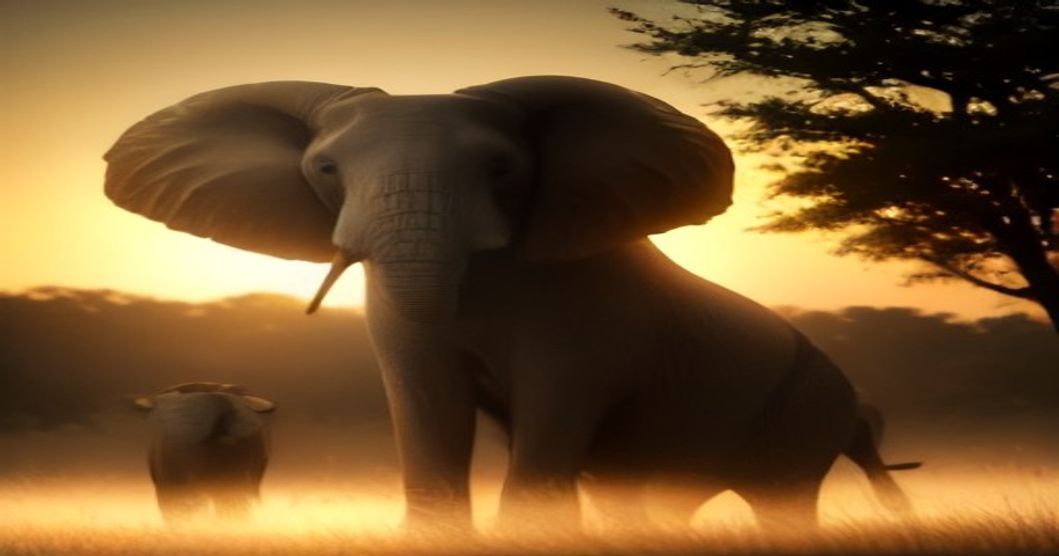
Social Dynamics and Bloodless Clashes
In the vast landscapes of the African savannah and Asian forests, elephants maintain intricate social structures governed by a clear hierarchy. To establish their standing within a herd without causing severe harm, these magnificent creatures often engage in bloodless clashes. These ritualistic displays of strength and posture allow individuals to assert dominance and determine rank peacefully, preserving the collective safety and health of the herd.
Unraveling the Mystery of Elephant Vocalizations
For decades, the exact mechanism behind elephant communication remained a profound biological mystery. Because much of their acoustic interaction occurs at frequencies imperceptible to humans, scientists struggled to understand how these calls were generated. A major scientific breakthrough came through research conducted by Dr. Christian Herbst at the University of Vienna. By studying the larynx of a deceased elephant, Dr. Herbst demonstrated that elephants utilize their vocal cords to produce sounds, employing physical principles similar to human vocalization rather than active muscular twitching.
A Sophisticated and Rich Vocabulary
The linguistic ability of elephants is remarkably complex. Dr. Herbst and his team documented approximately 470 distinct, stable signals that form the core of elephant language. These signals carry specific meanings and context-dependent nuances. Elephants use this vast vocabulary to coordinate herd movements over long distances, issue immediate warnings regarding threats, announce the arrival of newborn calves, and even address individual herd members differently depending on their position in the social hierarchy.
The Power of Infrasound
One of the most extraordinary aspects of elephant vocal behavior is their ability to produce infrasound. Elephants can generate acoustic signals at frequencies as low as 14 Hz, which sits comfortably below the lower limit of human hearing (around 20 Hz). These ultra-low-frequency rumbles travel for miles across the terrain, propagating through both the air and the ground as subtle seismic vibrations. Other elephants can perceive these ground vibrations through specialized nerve endings in their feet and trunks, allowing herds to stay connected across vast, dense landscapes.