
Venture into the bathypelagic depths of the world’s oceans, and you will encounter an ecosystem dominated by specialized evolutionary marvels. Among the most enigmatic predators inhabiting these sunless waters is Aphanopus carbo, commonly known as the Black Scabbardfish. Belonging to the family Trichiuridae (cutlassfishes), this deep-dwelling carnivore possesses an array of unique physiological and behavioral adaptations that allow it to thrive under intense atmospheric pressure and complete darkness.
Morphology and Distinct Anatomical Features
The morphology of the Black Scabbardfish is finely tuned for ambush predation in the deep sea. Structurally, the species exhibits a remarkably elongated, ribbon-like body with an iridescent, steel-blue to jet-black hue. Their scale-less skin is delicate, and their pelvic and caudal fins are significantly reduced or virtually absent, giving them a sleek, serpentine silhouette.
Perhaps their most formidable feature is their oral anatomy. Aphanopus carbo boasts a cavernous mouth lined with prominent, dagger-like fangs. These sharp, backward-curving teeth are essential for capturing and securing slippery cephalopods, crustaceans, and smaller mesopelagic fish in an environment where every feeding opportunity is critical for survival.
Habitat and Hydrodynamic Behavior
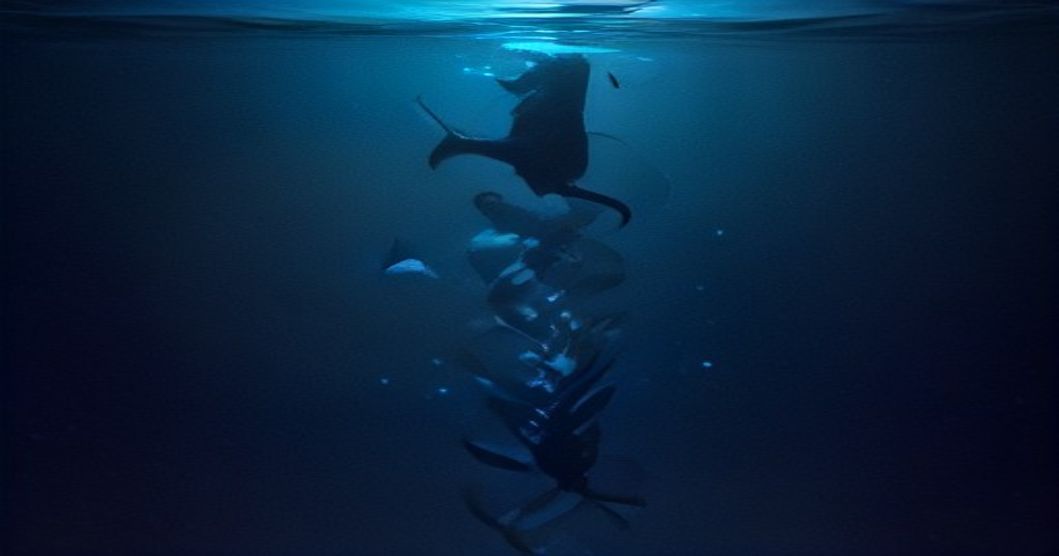
Occupying depths primarily between 800 and 1,300 meters, the Black Scabbardfish is distributed widely across the North Atlantic. Deep-sea submersibles operating in locations such as the deep waters off the Irish continental shelf have captured rare glimpses of their natural behavior. At depths exceeding 1,200 meters, researchers have observed these fish adopting a near-vertical hovering posture, slowly swaying above the seafloor.
This rhythmic, minimal-energy undulating motion enables them to conserve metabolic resources while scanning the water column above for the silhouettes of drifting prey. By remaining nearly stationary and maintaining neutral buoyancy, they blend seamlessly into the abyss before executing rapid, short-distance strikes.
Conservation Status and Deep-Sea Vulnerability
Despite their remote habitat, Black Scabbardfish are not insulated from human activity. They are subject to commercial deep-water longline fisheries and are frequently caught as bycatch in deep-sea bottom trawls alongside other fragile species. Like many deep-water organisms, Aphanopus carbo exhibits slow growth rates and delayed reproductive maturity, rendering their populations particularly vulnerable to overexploitation.
Understanding the life history, vertical migration patterns, and population dynamics of the Black Scabbardfish is vital for marine biologists and ocean conservationists. Establishing sustainable catch limits and protecting deep-sea ecosystems are essential steps toward ensuring that these ancient predators continue to patrol the ocean abyss for generations to come.