
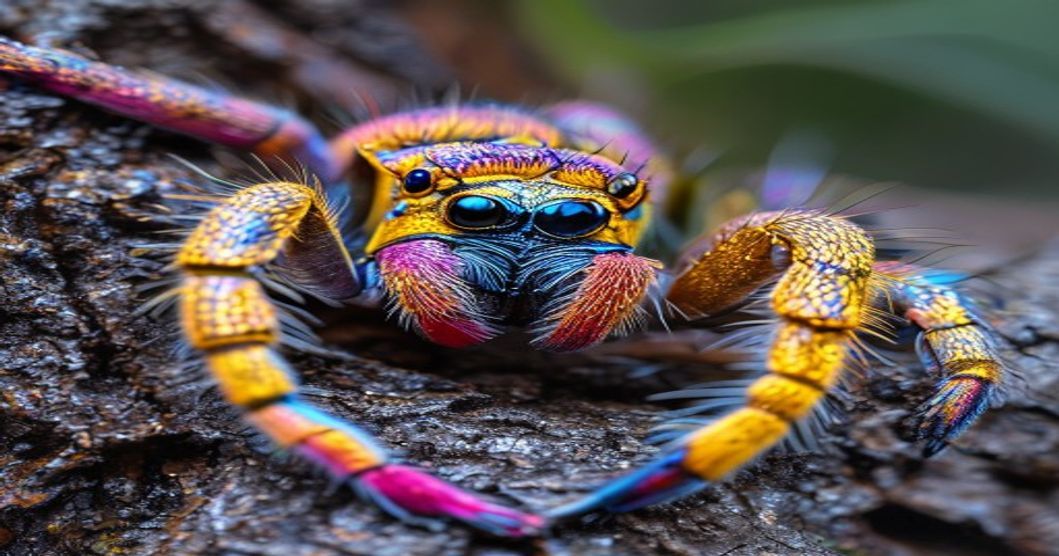
Among the vast array of arachnids inhabiting our planet, few species capture the imagination quite like the Brazilian Jewel Tarantula (Typhochlaena seladonia). Widely regarded as one of the most breathtaking spiders in the world, this miniature tree-dwelling gem offers a fascinating blend of brilliant coloration, unique architectural prowess, and intriguing behavioral adaptations.
A Spectacular Display of Color and Warning Signals
The defining characteristic of the Brazilian Jewel Tarantula is its striking, radiant palette. Their bodies display a dazzling array of hues, including iridescent blue, vivid yellow, intense red, soft pink, and deep black. Their two-toned legs shimmer brightly under light, earning them their shimmering reputation. However, this magnificent display is not just for show. In the wild, these vibrant colors function as an evolutionary defense mechanism known as aposematism, warning potential predators that the spider is unpalatable or toxic.
Diminutive Size and Arboreal Lifestyle
While many people associate tarantulas with large, heavy-bodied spiders, Typhochlaena seladonia is remarkably small. Males reach a modest leg span of 3 to 4 centimeters, while females are slightly larger, ranging from 4 to 6 centimeters. Unlike ground-dwelling tarantulas, this species is strictly arboreal, spending its entire life high up on tree trunks and branches in the tropical forests of Brazil.
Master of Camouflage: The Bark Trapdoor
One of the most extraordinary behaviors of this species is its hunting and shelter-building technique. The Brazilian Jewel Tarantula builds a cozy retreat hidden under tree bark, complete with a specialized camouflage trapdoor made of silk, bark bits, and lichen. Resting behind this invisible flap, the spider senses vibrations from approaching prey. Once an insect comes close enough, the tarantula opens the trapdoor, rapidly pounces on its target, and pulls it inside to feed.
Dietary Reality vs. Common Misconceptions
Despite being historically categorized within families colloquially known as “bird-eating spiders,” the Brazilian Jewel Tarantula does not hunt birds. Given their tiny size, their natural diet consists entirely of small tree-dwelling insects and invertebrates. The reference to bird-eaters stems purely from their taxonomic relationship to larger South American tarantula species.
Expert Care and Husbandry Perspective
Due to their rare beauty, these spiders are highly prized among exotic pet enthusiasts. However, caring for them requires specialized expertise. They are delicate creatures that demand precise humidity levels, proper cross-ventilation, and adequate cork bark substrate to allow them to build their characteristic trapdoors. Ensuring a stress-free environment and appropriate prey size is essential for maintaining the health and longevity of this enchanting miniature arachnid.