
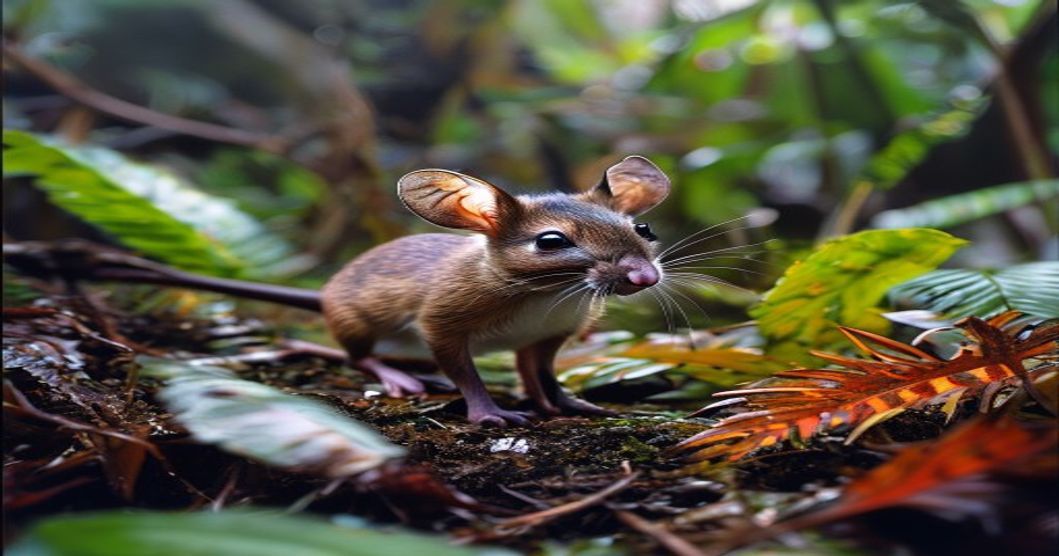
In the lush, shaded understory of Southeast Asian rainforests lives one of the animal kingdom’s most remarkable creatures: the Javan mouse-deer (Tragulus javanicus), locally known as the kanchil. Holding the impressive title of the world’s smallest even-toed ungulate, this fascinating mammal bridges the gap between delicate curiosity and wild survival.
Miniature Marvels: Physical Characteristics
Weighing a mere 1.5 to 2.5 kilograms (3.3 to 5.5 lbs) and standing at a shoulder height of just 20 to 25 centimeters, the mouse-deer is roughly the size of a small domestic cat or toy dog breed. Their bodies measure between 45 and 55 centimeters in length, supported by remarkably thin, pencil-like legs.
Unlike true deer, mouse-deer lack horns or antlers. Instead, evolution has gifted adult males with enlarged, sharp upper canines that protrude downward like miniature tusks. These specialized teeth are primarily used during territorial disputes and ritualized battles for mates.
Habitat, Secretive Behavior, and Lifestyle
Native to Java and found throughout tropical moist forests from southern China across the Malay Peninsula and the Greater Sunda Islands (Sumatra, Borneo, and Java), these creatures thrive in areas with extremely dense undergrowth, particularly near freshwater streams and riverbanks.
As extremely shy and solitary animals, kanchils lead a strictly nocturnal lifestyle. During the day, they seek refuge in rock crevices, hollow tree trunks, or dense foliage. At night, they venture out to forage along well-trodden, tunnel-like pathways that they carve through the thick rainforest brush. Their herbivorous diet consists mainly of fallen fruits, tender leaves, seeds, and young plant shoots.
Wildlife Health, Veterinary Care, and Conservation Welfare
From a veterinary and animal welfare perspective, the Javan mouse-deer possesses a highly specialized and delicate physiology:
- Extreme Stress Sensitivity: Like many small wild ungulates, mouse-deer are highly susceptible to capture myopathy—a dangerous metabolic condition caused by extreme fear and physical exertion. Handling these animals requires extreme gentleness, quiet environments, and minimal restraint.
- Nutritional Needs: Their simple, non-complex ruminant stomachs require a high-quality, easily digestible diet rich in natural fallen fruits and soft vegetation. In managed wildlife sanctuaries, keeping their gut flora balanced is critical to preventing gastrointestinal disorders.
- Habitat Preservation: Due to their small home ranges and reliance on thick undergrowth, forest fragmentation and habitat destruction pose severe threats to their welfare and survival. Additionally, while their tiny size might tempt some to view them as pets, they are wild, highly stress-prone creatures that do not thrive in domestic settings.
The Clever Trickster of Southeast Asian Lore
Despite their timid nature, the kanchil holds a legendary status in Indonesian and Malaysian folklore. Known as ‘Sang Kanchil,’ this miniature animal is celebrated as a master trickster who uses cleverness, speed, and intelligence to outwit much larger predators like tigers and crocodiles. Much like Br’er Rabbit in American folklore or the red fox in European tales, the mouse-deer proves that intelligence and agility can overcome physical size in the wild.