
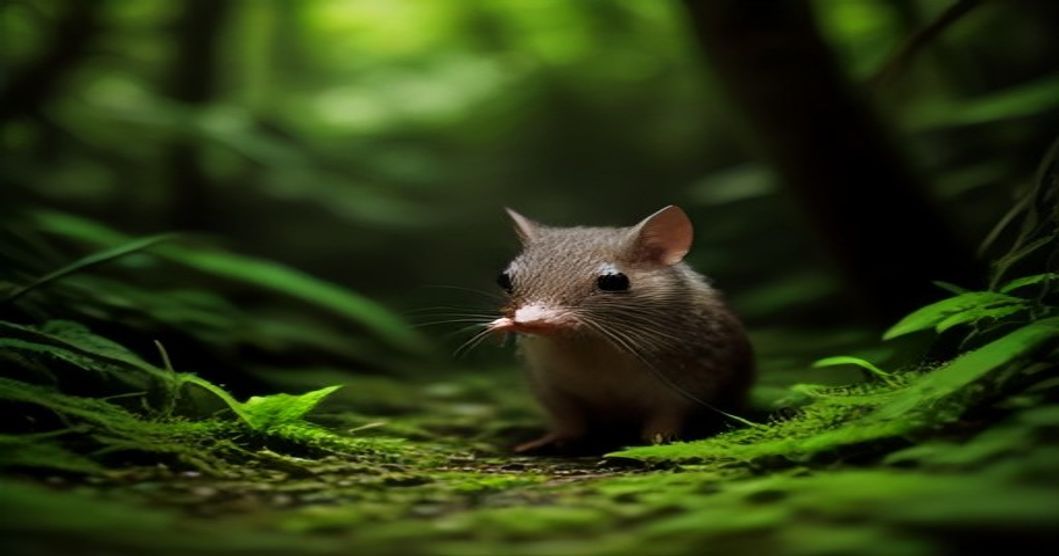
At a quick glance, you might easily mistake a shrew for a common field mouse. However, as veterinary professionals and wildlife experts will tell you, these miniature creatures belong to an entirely different biological order and possess some of the most extreme physiological adaptations in the animal kingdom. Far from being simple rodents, shrews are fierce insectivores that quietly dominate terrestrial ecosystems across the globe.
Not a Mouse: Understanding the Shrew Identity
Despite their physical resemblance to mice, shrews belong to the family Soricidae and are true insectivores. Unlike rodents, which are defined by continuously growing incisors built for gnawing, shrews possess rows of sharp, spike-like teeth engineered specifically for crunching through tough insect exoskeletons, earthworms, and small vertebrates. With an estimated global population of around 100 billion individuals, shrews are one of the most successful and widespread mammal families on Earth.
The Astonishing Shrew Caravan
One of the most captivating behaviors found in shrews—particularly within the genus Sorex—occurs when mothers move their young to a new nest site. To keep the family together, the litter engages in a behavior known as caravanning. The first youngster firmly grabs the base of the mother’s tail with its mouth, while the second sibling bites the tail of the first, forming an unbroken, train-like procession. This synchronized line allows the family to navigate dense underbrush safely without losing a single pup.
Mammalian Superpowers: Venom and Echolocation
Shrews possess biological adaptations that sound like something out of science fiction. A select few species, such as the short-tailed shrew, are venomous—a remarkably rare trait among mammals. Their paralytic saliva allows them to immobilize prey, creating living food stores to consume later. Furthermore, certain terrestrial and semi-aquatic shrews utilize a rudimentary form of echolocation. By emitting high-frequency squeaks and listening to the returning echoes, they can map out dark underground tunnels and dense leaf litter in total darkness.
A Metabolic Engine That Never Stops
The defining trait of shrew biology is an exceptionally high metabolic rate. A shrew’s heart can beat over 1,000 times per minute, burning energy at a breathtaking speed. To stay alive, a shrew must consume 1.5 to 2 times its own body weight in food every single day. Consequently, these tiny mammals spend their entire lives in a state of continuous hunting, punctuated only by brief catnaps.
Because their energy reserves are practically non-existent, starvation is a constant and imminent threat. Deprived of food, most small shrew species will succumb to starvation in just 7 to 9 hours. For the tiny lesser shrew, the window is even narrower—they can perish from starvation in as little as 5.5 hours. Understanding these incredible metabolic extremes highlights the sheer resilience required for such miniature predators to thrive on our planet.