
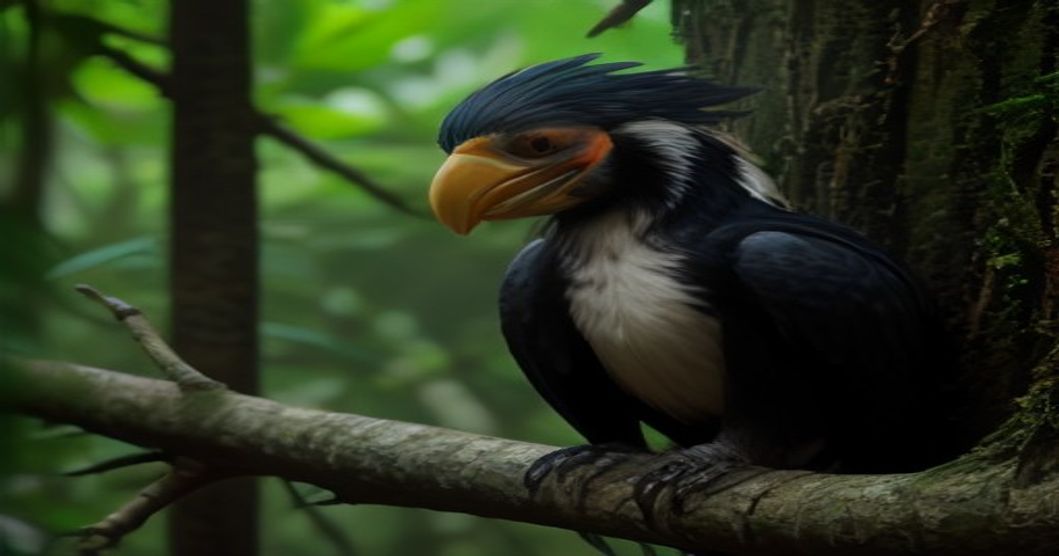
Introduction to the Helmeted Hornbill
The Helmeted Hornbill (Rhinoplax vigil) is one of the most magnificent and unique avian species inhabiting the dense rainforests of the Malay Peninsula, Sumatra, and Borneo. Renowned for their striking appearance and fascinating behaviors, these birds play a crucial role in maintaining the health of their forest ecosystems.
An Incredible Breeding Strategy
In the wild, you can sometimes observe a male hornbill tenderly feeding fruits to the female while she is deep inside a tree cavity, incubating their eggs. Once the female selects a suitable nest cavity and begins the delicate process of incubation, the male performs an extraordinary feat of avian engineering: he seals her entirely inside the cavity using mud, leaving only a tiny vertical slit!
Survival and Protection
This remarkable self-imprisonment is entirely driven by safety. By sealing the nest, the parents make it exceedingly difficult for egg-predating predators to detect or reach the vulnerable clutch. Later, when the chicks hatch and grow large enough, the male hornbill returns to break down the hardened mud barrier, finally reuniting with his family. Interestingly, behavioral studies and various sources suggest that the female can also break the mud seal from the inside if necessary—a vital evolutionary backup plan, considering the unpredictable fate that might befall the foraging male!
The Solid Casque: A Unique Anatomical Feature
As a veterinary and animal health observation, one of the most astonishing fun facts about the Helmeted Hornbill lies in its anatomy. Unlike other hornbill species whose casques (the large structure atop their beaks) are spongy and hollow, the Helmeted Hornbill possesses a casque that is completely solid and surprisingly heavy. This dense keratin structure accounts for roughly 10% of the bird’s total body weight, serving as a powerful tool for their dramatic aerial jousting and foraging behaviors in the canopy.