
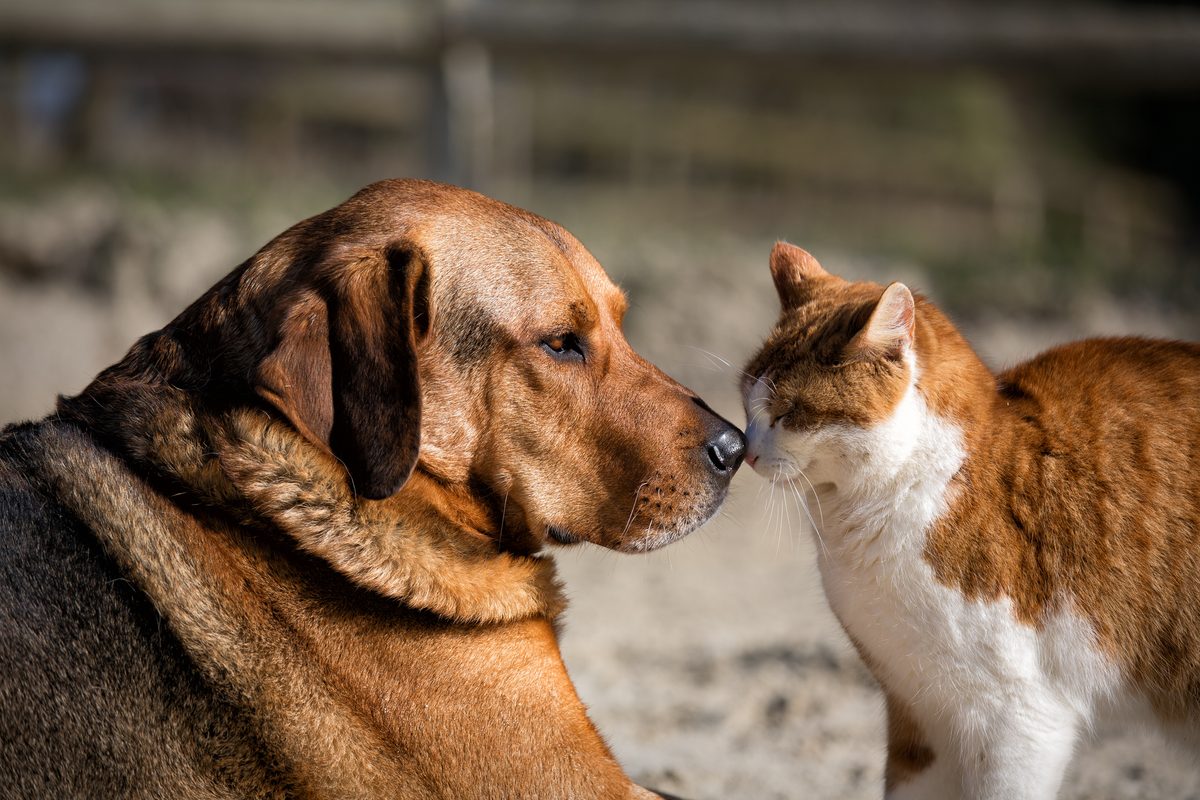
The Shared Roots of Our Favorite Pets
They might not see eye to eye today, but millions of years ago, dogs and cats shared more than just our affection—they shared common ancestors. If you go back roughly 45 million years ago, the world was devoid of dogs and cats. In their place was a burgeoning group of mammals that were largely nocturnal and looked a lot like weasels. From these small, humble beginnings emerged two lineages that would eventually give rise to our closest animal companions.
The Rise of Hesperocyon and Proailurus
As a group, dogs emerged 12 million years before cats, appearing in North America during the Late Eocene approximately 42.5 million years ago. Meanwhile, cats first evolved in Eurasia before migrating to the New World a few million years later. The first ‘true’ dog, known as Hesperocyon (or ‘western dog’), looked a bit like a cat and was about the same size as today’s smaller domesticated breeds. Interestingly, it was partially arboreal, spending a lot of its time in trees, though its undeniably dog-like skull and teeth gave it away.
On the feline side, Proailurus represents the first ‘true’ cat. Living approximately 30 million years ago in the Late Oligocene, it shared a similar body plan with Hesperocyon: an extended, low-slung body, relatively short limbs, and a long, flexible tail. Both ancient predators were likely omnivores, equipped with sharp canines for slicing meat and robust premolars for grinding tough foods like plants.
Miacids: The Last Common Ancestors
Canidae (dogs) and Felidae (cats) belong to the order Carnivora, a diverse group that also includes bears, hyenas, seals, and walruses. The first carnivoran-like animals, known as miacids, lived shortly after the asteroid impact that wiped out the dinosaurs around 65 million years ago. These weasel- or ferret-sized mammals are considered the last common ancestors of both dogs and cats, living for more than 30 million years and overlapping with early canine pioneers.
Are Humans Closer to Cats or Dogs?
While evolution treats us equally in the grand mammal family tree—splitting from a common carnivoran ancestor over 90 million years ago—genetics tells a fascinating twist. Modern dog ancestors underwent extensive chromosome rearrangements throughout history, whereas cats retained a genome organization closer to humans. This makes humans and cats twice as similar to each other as humans are to dogs in terms of gene arrangement within chromosomes!
Tracing Life Back to LUCA
The concept of relatedness stretches even further back. Absolutely everything alive today can trace its roots back to LUCA (the ‘Last Universal Common Ancestor’), a microscopic speck of life that lived roughly four billion years ago. From humans and cats to bacteria and fungi, all life shares this distant origin. Ultimately, whether looking at broad mammalian branches or ancient microscopic beginnings, the closeness of two organisms is entirely a matter of perspective.