
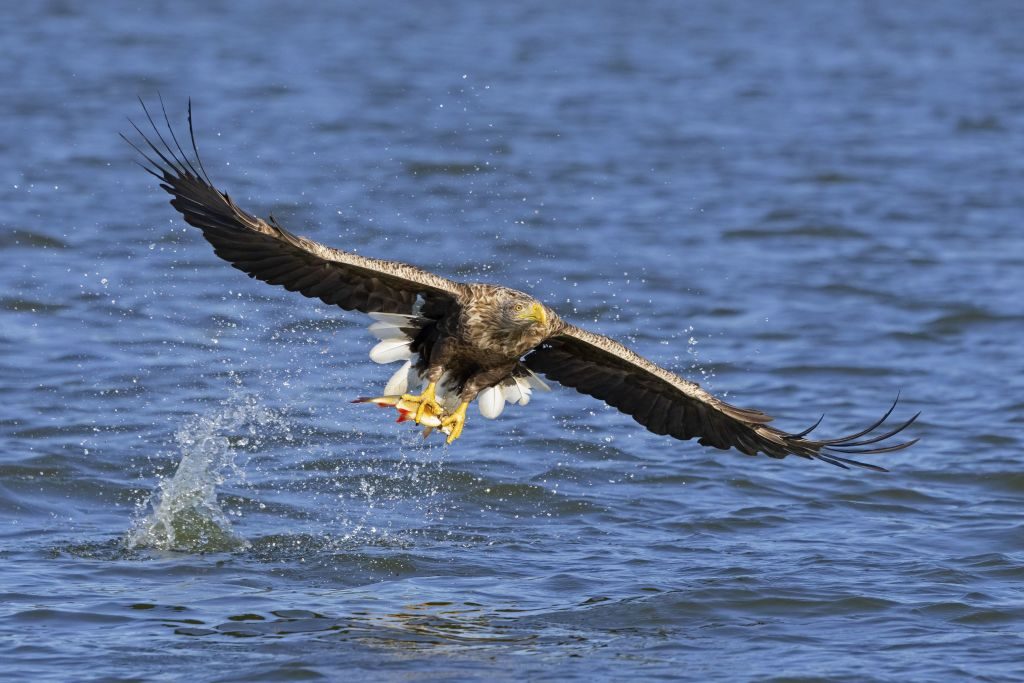
When we picture a bird of prey, formidable hunters like golden eagles, peregrine falcons, and silent owls instantly come to mind. Yet, countless other avian species survive solely by hunting living creatures. Herons spear fish and rodents along riverbanks, kingfishers dive with lethal precision, and penguins hunt marine life beneath freezing waters. Despite their predatory lifestyles, none of these species are classified as raptors. What creates this distinct biological divide?
The Anatomy of a Raptor: Talons, Beaks, and Etymology
The distinction between a general predatory bird and a true bird of prey boils down to evolutionary weaponry. The word raptor originates from the Latin rapere, meaning ‘to seize’ or ‘to take by force.’ Historically, the designation requires a specialized suite of physical adaptations: exceptional binocular vision, razor-sharp hooked beaks designed for tearing flesh, and powerful feet equipped with sharp, curved talons capable of snatching and subduing prey.
Similarly, the phrase ‘bird of prey’ translates from the 14th-century Old French oiseaux de proie (derived from the Latin avis praedae), highlighting birds that seize their quarry from the front. Birds such as storks, crows, and robins may consume meat, insects, or fish, but they dispatch their meals primarily with their beaks rather than grasping talons, placing them outside the raptor definition.
The Classification Dilemma: From Linnaeus to Modern Genetics
Classifying these birds has challenged naturalists for centuries. In the 18th century, Swedish taxonomist Carl Linnaeus grouped all known raptors under the order Accipitres, dividing them into four primary categories: vultures, falcons/eagles, owls, and shrikes. For centuries, physical appearance was the ultimate benchmark for classification.
However, the advent of DNA sequencing in the late 20th century turned traditional avian taxonomy on its head. Genetic analysis revealed that several birds sharing nearly identical physical tools evolved independently through convergent evolution.
The Vulture Paradox and Nature’s Exceptions
Vultures provide a prime example of taxonomic complexity. Although they primarily scavenge rather than hunt live game, their curved beaks and taloned feet historically placed them among raptors. Genetic mapping revealed that Old World vultures (native to Europe, Asia, and Africa) are closely related to true hawks and eagles, whereas New World vultures (native to the Americas) share closer evolutionary ties with storks and cranes.
Other species continue to blur the lines. The African secretary bird boasts the hooked beak and talons of a classic raptor alongside the extraordinarily long legs of a wading crane. As our understanding of avian genetics evolves, one truth remains clear: nature rarely adheres to neat human definitions.