
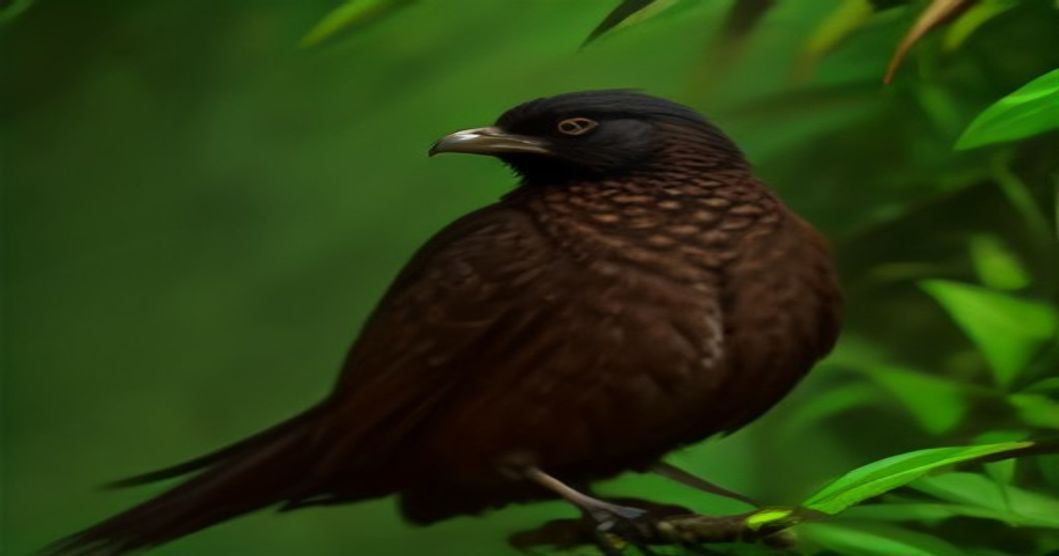
An Extraordinary Member of the Cuckoo Family
When most people think of cuckoos, the first behavioral trait that comes to mind is brood parasitism—the practice of laying eggs in the nests of other bird species and leaving the foster parents to raise the chicks. However, the avian world is full of remarkable exceptions. Among the most striking of these is Centropus sinensis, commonly known as the Greater Coucal or Crow Pheasant. Belonging to the family Cuculidae, this magnificent bird breaks the conventional mold by building its own nest, incubating its eggs, and devotedly rearing its own offspring.
Morphology and Distinctive Characteristics
The Greater Coucal is a relatively large, robust bird, roughly equivalent in size to a common crow, measuring up to 50 centimeters (approximately 20 inches) in total length. A defining physical attribute is its long, wide, and rounded tail, which accounts for nearly half of its overall body length. Its plumage displays a striking contrast: rich chestnut-brown wings set against a deep, glossy black-to-purple head, body, and tail.
Its genus name, Centropus, is derived from the Greek words for ‘spur’ and ‘foot,’ highlighting another unique anatomical feature—a remarkably long, straight claw on its hind toe (hallux). This specialized claw aids the coucal in clambering through thick, tangled undergrowth rather than relying purely on flight.
Habitat and Distribution
Native across the Indian subcontinent and Southeast Asia, including extensive populations in India and Sri Lanka, the Greater Coucal thrives in diverse ecosystems. It is frequently observed in open scrublands, agricultural borders, marshy edges, dense secondary forests, and suburban gardens. As a predominantly ground-dwelling and terrestrial forager, it moves stealthily through dense vegetation in search of insects, small reptiles, amphibians, and seeds.
Remarkable Nesting Architecture and Parental Dedication
Unlike parasitic cuckoos, both the male and female Greater Coucal participate actively in the reproductive cycle. They construct their nests relatively close to the ground, concealed within thick, impenetrable thorny bushes, tangled vines, or dense tree branches to protect the clutch from predators.
The nest itself is an impressive architectural feat. It is a roughly spherical, domed structure with a protective roof, woven skillfully from twigs, dried leaves, and grasses. Access to the interior is gained through a discreet side entrance. Due to the bird’s substantial size and modest dimensions of the nest chamber, an amusing and characteristic sight during breeding season is the parent bird’s long tail feathers visibly protruding from the nest entrance while diligently incubating the eggs or brooding the hatchlings.
Avian Health and Ecological Importance
From an ecological and wildlife health perspective, coucals serve as vital biological pest controllers within their native habitats. Their opportunistic, omnivorous diet helps manage populations of agricultural pests, garden insects, and small rodents. Understanding the distinct reproductive biology and behavior of non-parasitic cuckoos like Centropus sinensis provides invaluable insights into avian evolution, highlighting the diverse survival strategies that allow these fascinating birds to flourish.