
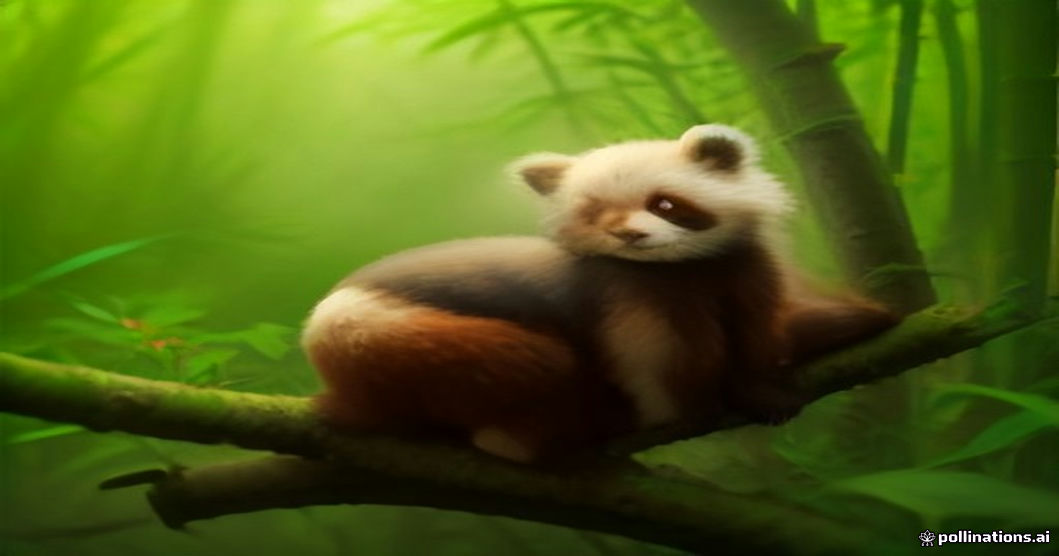
High in the misty temperate montane forests of the Eastern Himalayas, a flash of russet fur navigates the moss-draped branches of ancient fir trees. The red panda (Ailurus fulgens) is a true evolutionary marvel—neither a close cousin of the giant panda nor a simple raccoon relative, but the sole surviving member of the family Ailuridae. To understand the life of this enigmatic mammal is to appreciate a delicate balance of specialized anatomy, unique metabolic adaptations, and extreme ecological vulnerability.
Dawn Awakening: The First Foraging Bout
Red pandas are predominantly crepuscular, meaning their peak activity aligns with the twilight hours of dawn and dusk. As the first light filters through the dense canopy, a red panda stirs from its sleeping perch. Unlike ground-dwelling omnivores, the red panda begins its day high above the forest floor, using its semi-retractable claws and remarkably flexible ankles—which can rotate up to 180 degrees—to climb headfirst down vertical trunks with peerless agility.
The morning priority is immediate and critical: nutrition. While taxonomically classified within the order Carnivora, red pandas maintain a diet that is almost entirely herbivorous, with bamboo constituting upwards of 90 to 95 percent of their intake. Using an enlarged radial sesamoid bone known as a ‘false thumb,’ the red panda deftly grasps bamboo culms, stripping fresh leaves and young shoots. Because bamboo is rich in indigestible cellulose and low in protein, an adult red panda must consume up to 20 to 30 percent of its body weight in fresh bamboo leaves each day simply to maintain baseline metabolic homeostasis.
Midday Rest and Thermoregulation
By late morning, as ambient temperatures fluctuate, the red panda retreats back into the sheltered middle canopy. Because their diet provides a remarkably low caloric return, red pandas have evolved a basal metabolic rate comparable to that of sloths. Energy conservation is vital to survival.
During warm periods, a red panda may stretch out lengthwise across a broad branch, allowing air to circulate around its pale underside to dissipate heat. Conversely, during the freezing winds common to their high-altitude range, the animal curls into a tight ball, wrapping its luxuriant, dense, ringed tail completely over its face. This specialized tail acts as an organic respiratory insulator, trapping warm exhaled air and shielding the eyes and nose from frostbite.
Afternoon Grooming and Territorial Scent-Marking
In the late afternoon, the red panda resumes its solitary routine with meticulous self-care. Cleanliness is essential for maintaining the insulation properties of their dense, double-layered coat. Using forepaws moistened with saliva, red pandas groom their faces, ears, and flanks in a cat-like fashion, methodically removing parasites and sap from the dense woolly underfur.
As solitary animals, social communication relies heavily on chemical signaling rather than direct confrontation. As the red panda traverses its territorial perimeter, it frequently marks branches using specialized perianal and plantar scent glands located beneath the paws. By pressing its scent against bark or leaving targeted latrine deposits, it communicates sexual receptivity, health status, and boundaries to neighboring conspecifics without risking costly physical conflict.
Veterinary Insight and Conservation Realities
From a veterinary and conservation medicine standpoint, the red panda represents a highly specialized physiology with minimal margin for environmental stress. Their short, unspecialized gastrointestinal tract processes food rapidly—often within two to four hours—leaving them vulnerable to gastrointestinal dysbiosis, endoparasites, and seasonal dietary shortages. Furthermore, habitat fragmentation directly limits their access to continuous bamboo understories, severely impacting genetic diversity and nutritional resilience.
As dusk settles into night and the red panda completes its final feeding cycle, this solitary canopy dweller retreats once more to the safety of the upper boughs. Preserving the delicate biological rhythms of the red panda requires comprehensive landscape conservation, ensuring that these arboreal masterworks continue to thrive across their native Himalayan wilderness.