
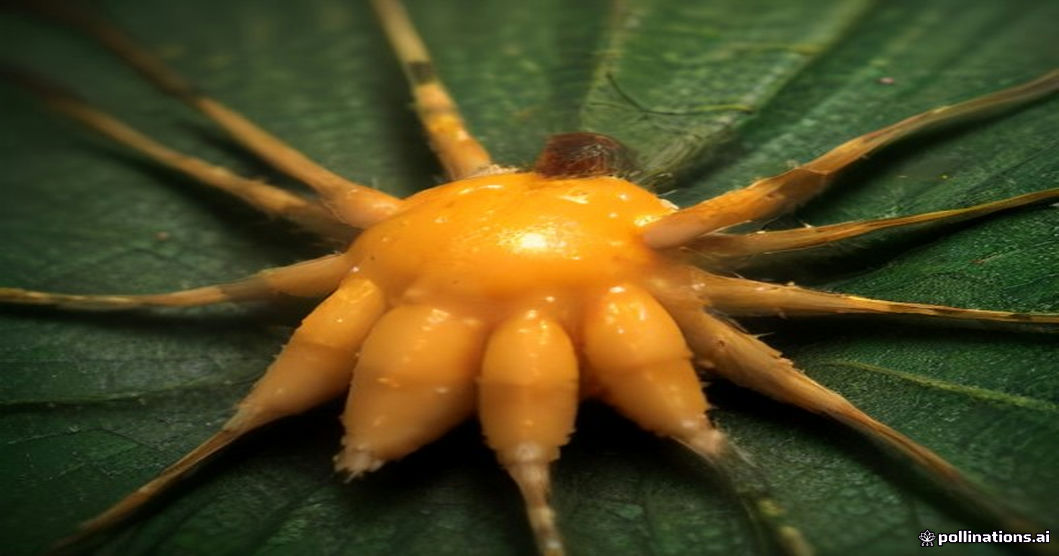
Among the vast and diverse world of arachnids, few creatures captivate the imagination quite like the Longhorn Orb-Weaver (Macracantha arcuata). Often categorized under the broader umbrella of spiny orb-weavers, this extraordinary species looks less like a typical backyard spider and more like an alien relic or a carefully sculpted jewel. Characterized by dramatic, antenna-like spines curving high into the air, this spider represents one of nature’s most eccentric adaptations in evolutionary morphology.
Striking Anatomy and Sexual Dimorphism
The most defining feature of Macracantha arcuata is undeniably its pair of elongated abdominal spines. These horn-like projections, which can cause the spider to span up to three centimeters from tip to tip, rise gracefully from a hardened, shell-like abdomen known as a carapace. In addition to being structurally remarkable, the abdomen displays brilliant aposematic coloration—vivid shades of white, bright yellow, or deep orange frequently accentuated with bold red markings and dark sigilla (indentations).
As with many members of the family Araneidae, the Longhorn Orb-Weaver exhibits pronounced sexual dimorphism. The flamboyant horns and vibrant palettes belong exclusively to the females. In stark contrast, male longhorn orb-weavers are dramatically smaller, measuring only a fraction of the female’s size, and entirely lack the iconic curving spines. This stark physical divergence allows males to move inconspicuously through vegetation while searching for a mate without attracting the attention of sharp-eyed avian predators.
Defensive Adaptations and Natural Habitat
While the long spines may look intimidating or aggressive, they serve a purely defensive purpose. To a foraging bird or small reptile, attempting to swallow a hardened, spiny-backed orb-weaver is a hazardous and uncomfortable ordeal. The sheer span of the spines combined with the tough, chitinous exoskeleton makes the spider physically difficult to ingest, while the bright colors provide an unmistakable visual warning that the prey is neither easy nor palatable.
Native primarily to the humid, tropical, and subtropical forests of Southeast Asia and India, these spiders thrive in environments rich in foliage and insect biodiversity. Related species of spiny orb-weavers with similar defensive adaptations also grace foliage in other warm regions worldwide, including the southeastern United States, showcasing the global success of the spiny body plan.
Master Engineers of the Forest
The artistic flair of the Longhorn Orb-Weaver extends beyond its physical shell to its master craftsmanship. True to their orb-weaver heritage, these spiders construct enormous, geometrically precise webs suspended between branches and shrubs. A single web can span over a meter in diameter, featuring intricate spiral radials anchored by remarkably strong structural silk lines. These vast nets are positioned strategically in flight corridors to intercept flying insects such as flies, moths, and mosquitoes, making the longhorn orb-weaver an indispensable contributor to biological pest control.
Safety for Humans and Pets
Despite their somewhat menacing silhouettes, Longhorn Orb-Weavers are entirely harmless to humans, dogs, and cats. They are timid, docile invertebrates that prefer to remain stationary in the hub of their webs rather than confront larger organisms. Their venom is specialized solely for immobilizing tiny prey and poses no clinical threat to domestic pets or people. An accidental encounter or defensive bite, which is extraordinarily rare, results in nothing more than minor, localized irritation comparable to a mild pinprick.
Ultimately, Macracantha arcuata stands as a brilliant testament to the architectural and evolutionary wonders of the animal kingdom—a benign, hard-working garden ally masquerading as a horned mythical beast.