
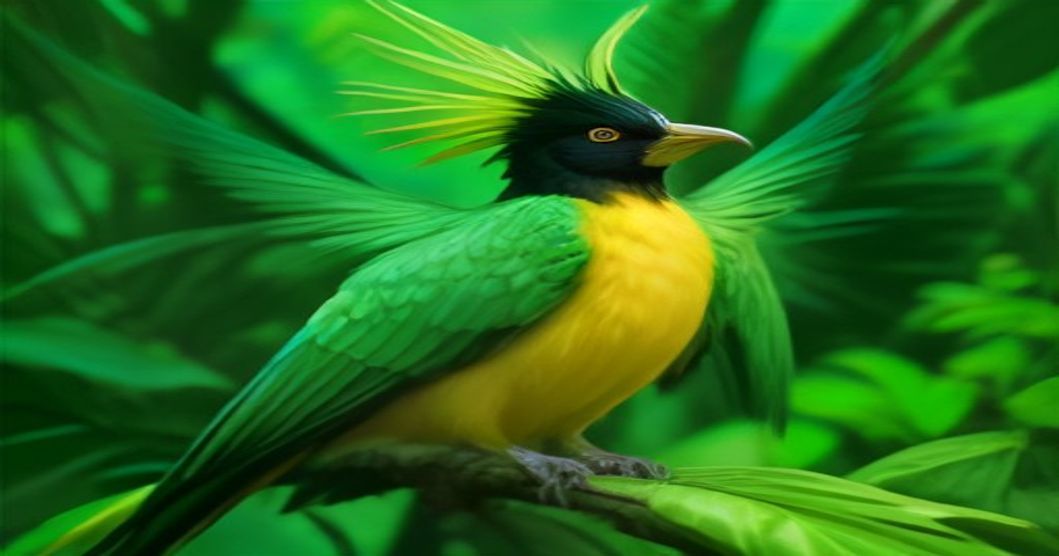
Introduction to a Forest Marvel
Hidden within the dense, tropical canopies of Australasia lives one of the most visually stunning and behaviorally complex avian species on Earth: the Magnificent Bird-of-Paradise (Cicinnurus magnificus). Measuring around 26 centimeters in length, this compact passerine captivates ornithologists, biologists, and wildlife enthusiasts alike with its extraordinary courtship rituals and astonishing physical appearance.
Extraordinary Sexual Dimorphism and Plumage
Like many members of the Paradisaeidae family, the Magnificent Bird-of-Paradise exhibits pronounced sexual dimorphism, reflecting strong evolutionary pressures driven by female mate selection. The adult male is a masterclass in natural iridescence and color saturation. He possesses bright sulfur-yellow wings, an iridescent emerald-green breast shield, vivid turquoise-blue feet, and an equally striking pale blue beak. A flared, cape-like collar of golden-yellow feathers encircles his neck, while two elongated, sickle-shaped, wire-like tail feathers gracefully curve outward behind him.
In stark contrast, the female displays a modest, cryptic plumage dominated by muted olive and greenish-brown tones with fine barring across the underparts. This evolutionary adaptation serves a vital biological purpose: ensuring total camouflage while incubating eggs and rearing young, protecting the nest from keen-eyed rainforest predators.
Habitat and Nutritional Ecology
The Magnificent Bird-of-Paradise is native to the hill and lower montane rainforests of Western New Guinea and Papua New Guinea. Within these humid, biodiverse ecosystems, these birds occupy the understory and mid-canopy layers. Their diet is predominantly frugivorous, heavily centered on nutrient-dense tropical fruits, supplemented occasionally by small arthropods for vital protein intake. Through their fruit consumption, these birds play an essential ecological role as key seed dispersers across the tropical forest floor.
Choreography of the Wild: The Courtship Arena
Perhaps the most remarkable aspect of the Magnificent Bird-of-Paradise is the male’s meticulous preparation for courtship. Unlike birds that rely solely on song, the male establishes a dedicated display court on the forest floor. He methodically clears away fallen leaves, twigs, and debris, ensuring an unobstructed stage where sunlight can pierce the canopy and illuminate his iridescent plumage.
When a prospective female arrives, the male initiates an intricate, multi-sensory performance. He erects his vivid yellow cape over his head, expands his iridescent green breast shield into a gleaming disk, and synchronizes crouching, rhythmic hopping, and lateral swaying with a series of distinct buzzes, clicks, and vocalizations. This energetic performance allows the discerning female to evaluate the male’s genetic fitness, vitality, and morphological symmetry before choosing to mate.
Avian Health, Welfare, and Conservation Insights
In avian medicine and wildlife conservation, species with specialized display behaviors and narrow ecological niches like Cicinnurus magnificus serve as vital bioindicators. Their reproductive success depends directly on the structural integrity of primary rainforest habitats and the abundance of fruiting flora. Protecting these pristine environments ensures the continued survival of one of nature’s most sophisticated and breathtaking living masterpieces.