
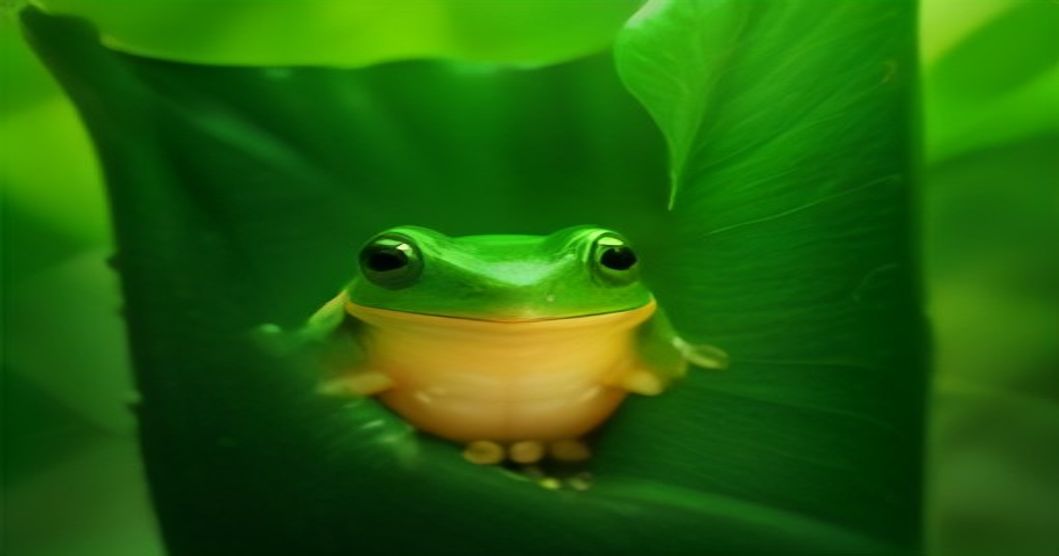
Deep within the humid, lush rainforests of Central and South America lives one of nature’s most extraordinary masterpieces: the glass frog (belonging to the family Centrolenidae). While many amphibians rely on vibrant warning colors or complex pattern matching to avoid becoming a meal, the glass frog takes camouflage to an entirely new dimension. Through a rare evolutionary phenomenon, this tiny tree dweller uses semi-transparent skin to alter its appearance dynamically, rendering itself virtually invisible to searching eyes.
The Physics of Invisibility: Softening the Silhouette
The primary survival challenge for any small tree frog is hiding from hungry predators operating below and above them in the forest canopy. Most animals cast a stark, easily identifiable silhouette when perched on a bright, sunlit leaf. The glass frog circumvents this danger through the sheer thinness and translucency of its integument. When sunlight hits the frog’s body, light partially passes through its tissues rather than being completely blocked, casting an exceptionally faint shadow.
For predators looking up from beneath the foliage, the absence of a harsh dark outline makes the frog almost impossible to distinguish from the leaf itself. Furthermore, when viewed from above, the frog’s translucent legs blur its outer boundaries. This effect, known scientifically as edge disruption through translucency, blends the frog’s borders seamlessly into the surrounding green background.
Scientific Discoveries: How Predators Perceive the Glass Frog
To understand exactly how effective this visual trick is, researchers conducted a groundbreaking study involving 55 glass frogs photographed against both natural green leaves and stark white backgrounds. Using specialized computer modeling designed to mimic the visual processing of natural predators—such as birds and snakes—scientists thoroughly analyzed the frogs’ coloration, luminance, and outline definition.
The study revealed a fascinating mechanism: the frogs appeared lighter or darker automatically depending on the background surface. Crucially, this luminance adjustment is not achieved through active physiological color changes like those seen in chameleons or cuttlefish. Instead, it is a passive optical effect driven entirely by the body’s semi-transparency. The delicate limbs, which are significantly more transparent than the central torso, shift dramatically in perceived brightness to match whatever substrate the frog rests upon.
A Living Anatomical Lesson
Beyond its evolutionary camouflage tactics, the glass frog possesses one of the most stunning anatomical quirks in the animal kingdom. The skin on its ventral side (underbelly) lacks dark pigmentation entirely, rendering it completely clear like window glass. Observers can directly view the frog’s inner workings in real time, including its beating heart, winding digestive tract, and delicate blood vessels.
This incredible adaptation reminds us of the endless complexity of amphibian biology. As delicate indicators of ecosystem health, glass frogs demonstrate how marvelous—and fragile—rainforest biodiversity truly is. Protecting their natural habitats ensures that these living gems continue to thrive and fascinate researchers for generations to come.